To mark its 40th anniversary, Espace Porcelaine wanted the temporary exhibition to embody the spirit of the Casseaux kiln: a key part of our heritage that was celebrated in its heyday, then fell into obscurity, and is now recognized once again.
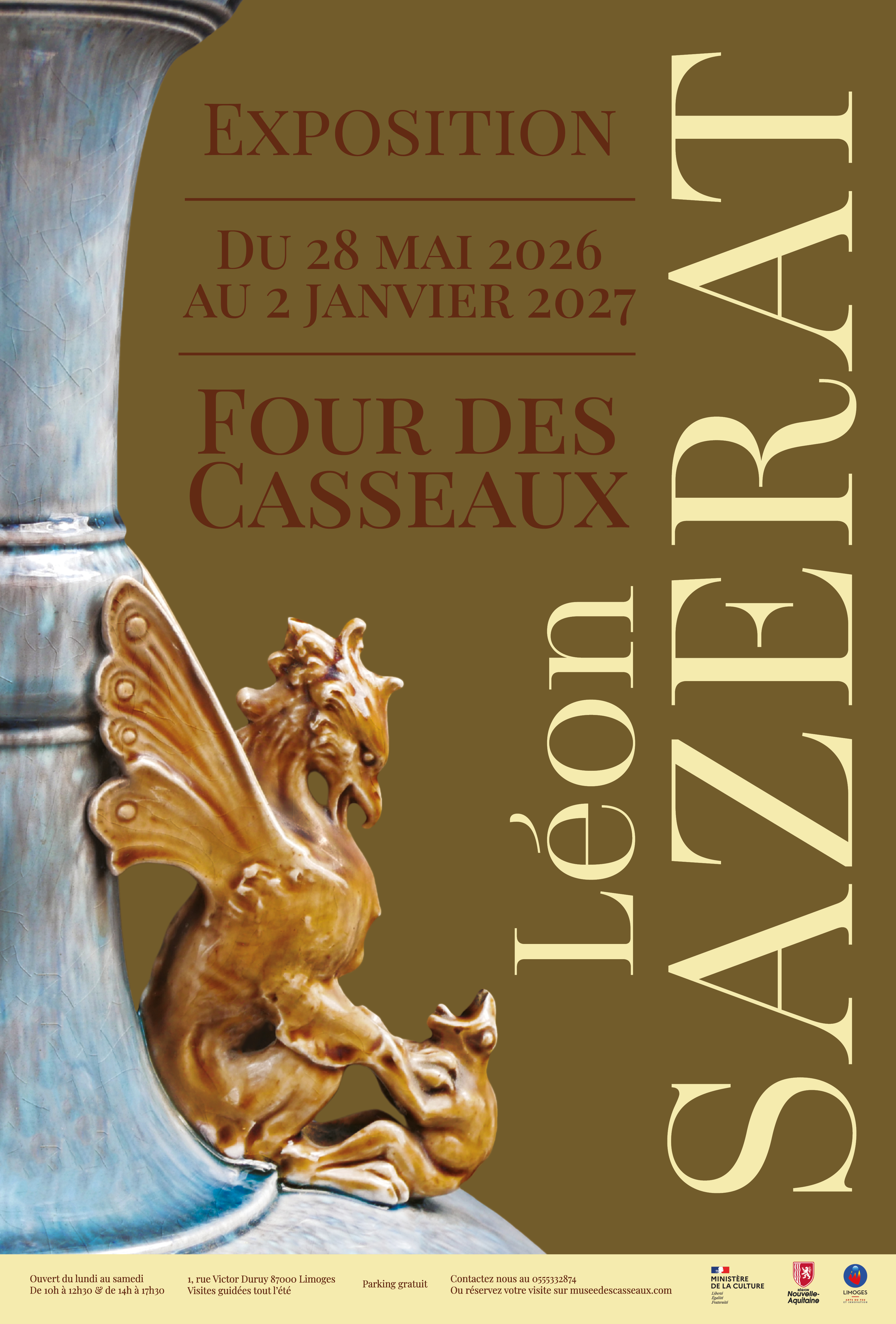
In this regard, Léon Sazerat embodies everything that Espace Porcelaine stands for: Limoges, ceramics, technical challenges, and artistic exploration. Léon Sazerat (1831–1891) was born and raised in Limoges, where he was trained from a very young age in the workshops of a rapidly expanding porcelain-making town. In 1852, he took the reins of his first workshop on Boulevard Saint-Maurice and quickly built a reputation for himself. David Haviland commissioned numerous designs from the young and talented modeler. His catalog expanded, and he was recognized at the 1855 World’s Fair in Paris for the quality of his bisque pieces, winning a silver medal. This first award fueled his thirst for challenges and recognition.
In 1859, he went into business with his father-in-law, Pierre Blondeau (1812–1903), and built a new factory in the Montjovis suburb equipped with two kilns. Wood-fired kilns were replaced by coal-fired ones, production ramped up, and the workforce grew to nearly 100 people. Léon Sazerat continued his research and showcased his work throughout France. A chance encounter would change the fate of this factory and Léon Sazerat’s creations. Pierre-Adrien Dalpayrat (1844–1910), a brilliant ceramist from Limoges, had returned to his hometown. Among other things, he had trained at Jules Vieillard’s earthenware factory in Bordeaux. An artist at the forefront of his time, Dalpayrat was recruited by Sazerat as a decorator. The two men respected and got along well with one another, and from this meeting onward, the porcelain factory added artistic earthenware to its production. This move seemed paradoxical in the porcelain capital, but earthenware clay offered greater sculptural possibilities and allowed for a rich range of glazed colors. This initiative aligned with the direction Léon Sazerat sought to establish: on one hand, a standard production line featuring tableware sets and various porcelain utility items; and on the other, an artistic line produced in earthenware.
Thus, in 1878, at the Paris World’s Fair, the Sazerat factory attracted attention for two reasons: its porcelain and its earthenware. The artistic earthenware pieces alternated between historical subjects in the neoclassical and neo-Gothic styles but gradually shifted toward the influence of the era: Japonism. Indeed, like the great ceramist Théodore Deck (1823–1891), Léon Sazerat was captivated by artistic works from Japan and, more broadly, the East. His repertoire of forms expanded, with many new shapes and elements drawing on Japonism and Orientalism. Even today, this period of production remains the pinnacle of his career, in terms of the quality of execution and the colors of the grand feu glazes.
His recognition came in 1888, when he was honored by President Sadi Carnot during the latter’s visit to Limoges. Léon Sazerat passed away in 1891 at the age of 60. The Léon Sazerat monographic exhibition is the first retrospective dedicated to him since his death over a century ago. After extensive historical and genealogical research, as well as consultations with knowledgeable collectors, Espace Porcelaine has gathered over a hundred creations at the Casseaux kiln that bear witness to his prowess and talent. For this special occasion, Espace Porcelaine is also publishing an art book—a hybrid of exhibition catalog and catalogue raisonné—to ensure that Léon Sazerat’s work takes its rightful place among the great ceramic artists of the 19th century.